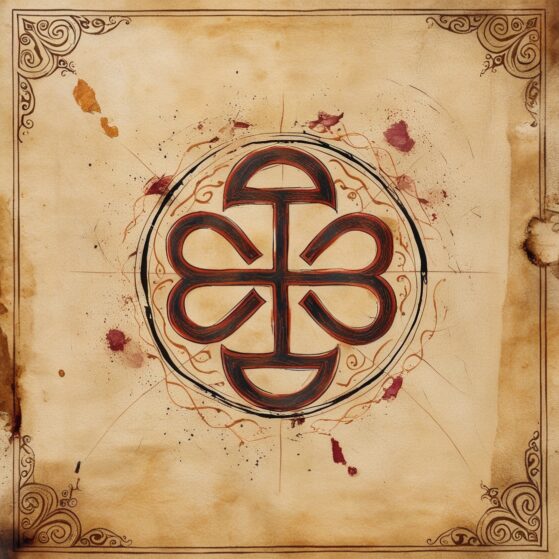
The Third Passage
There is a law—ancient, unspoken—that says the third is never just the next. It is the convergence, the pivot, the turning of the mirror inward. Trijo is this moment. The third breath. The third wound. The third flame.
By now the symbol has changed once again. It no longer lies dormant on the cover—it radiates. Threefold. Interlocking shapes pulsing with the weight of geometry too precise to be human, yet too haunted to be machine. Some see eyes in it. Others, maps. All agree: it feels alive.
Trijo does not begin—it emerges, like a memory you didn’t know you carried. Sounds fold over each other like silk and steel. Instruments speak in riddles. A bowed string becomes a lament, then a warning. Percussion drips like water echoing down a spiral well. Guitars return, but like spirits threading the air.
Where Phrumo was the seed, and Dujto the root descending, Trijo reaches outward—searching, splitting, ascending. It is the revelation that comes after forgetting. The paradox of becoming something you always were.
Listeners say Trijo is the most human of the three, yet also the most alien. It hums with emotion, yes—but emotion filtered through something vast, something watching. There are songs that feel like prayers, and others like storms. All of them echo with the pull of something final—but finality, here, is an illusion.
Trijo is not closure. It is triangulation. The forming of shape. The first glimpse of structure in the chaos. The music no longer wanders—it circles. It beckons.
There is something on the horizon now: the Na Samrat‘s holy trinity.